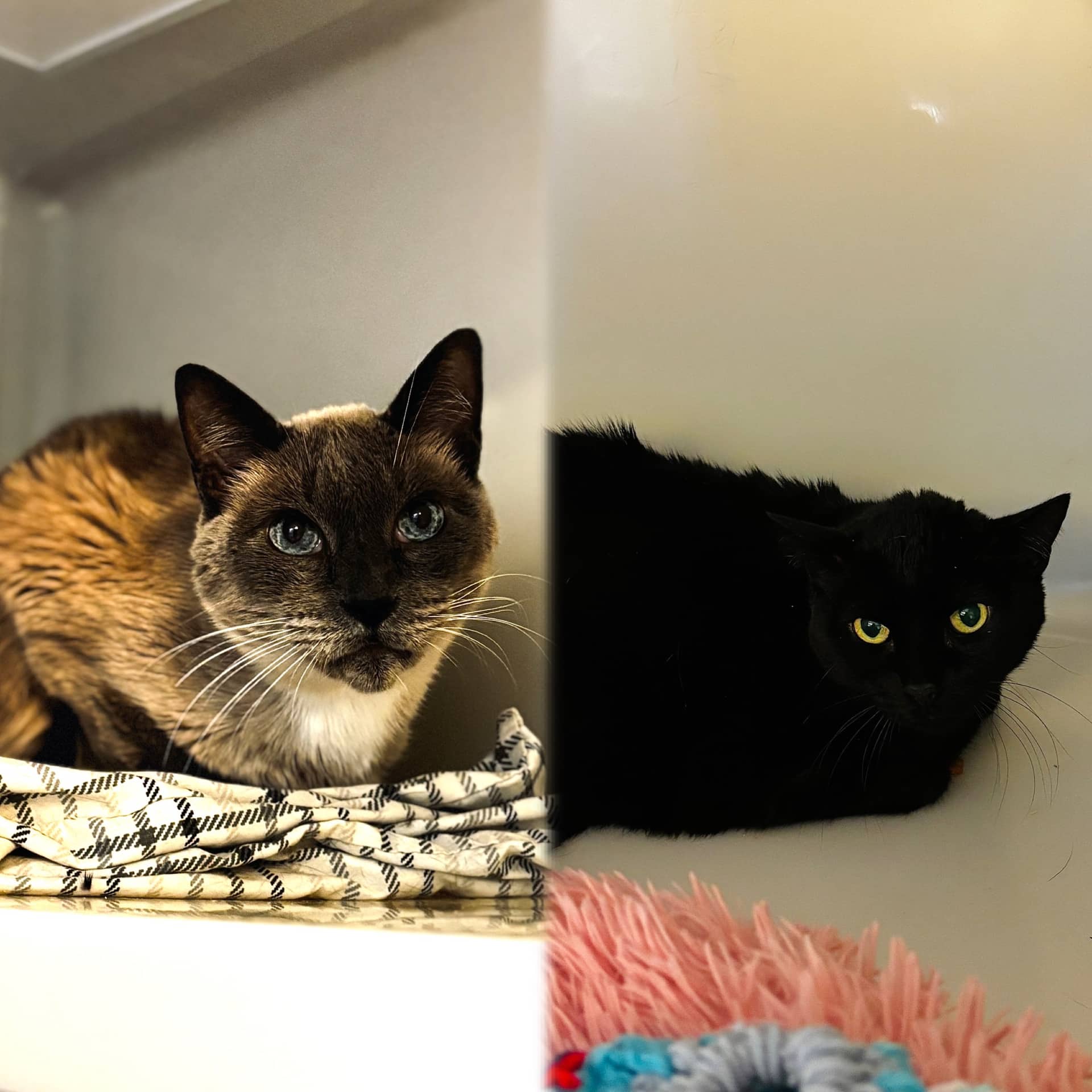
Wayne & Garth
Domestic Short Hair, Siamese
All Creatures Great and Small· Near Cwmbran
Meet Wayne & Garth →Siamese cats and Siamese crosses looking for new homes with rescues and rehoming centres across the UK.
1 listed across the UK from 1 rescue
Showing 1 cat
Never miss new Siamese cats
Be first to know when new Siamese cats are listed across the UK. No spam, unsubscribe any time.
Domestic Short Hair, Siamese
List your cat for free. Your cat stays at home until you find the right family, every listing is checked by a person, and you choose who adopts. Not sure yet? Read the rehoming guide first.
List your cat for free →1 siamese is listed across the UK today, all with one rescue. The newest was added on 13 October 2026.
Breed labels on listings are often a best guess from appearance. Read each profile, then ask the rescue about the cat’s history and the home they need.
| GCCF section | Siamese and Oriental |
|---|---|
| Size | 8 to 15 lb (males 10 to 15 lb, females 8 to 12 lb) |
| Coat | Short and fine |
| Maintenance | Low |
| Lifespan | 10 to 15 years |
| Colours | Many colour combinations (32 colours and points patterns) |
| Temperament | Outgoing, extrovert and noisy |
The Governing Council of the Cat Fancy (GCCF), which registers pedigree cats in the UK, describes the Siamese as "outgoing, extrovert & noisy". It says the breed is "probably as well known for its loud vocal personality as for its classic looks", and that Siamese are highly intelligent and demand attention.
The best known feature is the coloured points on the face, ears, legs and tail, with deep blue eyes. The GCCF notes this pointed pattern has also been bred into other breeds, such as the Persian and the British Shorthair, so a colourpoint cat is not always a Siamese.
The breed has been in Britain a long time. The GCCF says the first Siamese to arrive in the UK were a pair brought back from Bangkok in 1884, and that their kittens were shown at the Crystal Palace show in 1885. Cats Protection notes that "old style" Siamese had rounder faces and stockier bodies, while modern Siamese are "super slim" with long legs and triangle-shaped heads.
A rescue cat is an individual, and a colourpoint cat in rescue may be a cross. The rescue knows how this cat behaves at home, so ask them.
The GCCF says "a Siamese is not an ideal cat for someone out at work all day as they do not like to be left on their own", though it adds this can be overcome by having two Siamese. They need to be kept amused, and the GCCF suggests toys and scratching posts. It says they can be taught to retrieve toys.
The GCCF says "the Siamese cat's short glossy coat does not require excessive grooming", though most will enjoy the attention. As with most shorthair breeds, it says, the cats look after their own coat very well.
The GCCF says the eye squints and kinked tails of the original Siamese are now considered serious faults, and lists several conditions linked to the breed. It says some lines may be predisposed to some cancers, including mediastinal lymphoma and some intestinal tumours, and that Siamese seem to suffer more from chronic coughing (asthma) and to vomit more than other breeds. Cats Protection also says Siamese cats can be more commonly affected by feline asthma.
The GCCF says some lines eat non-food items such as woollen clothes and plastic (known as pica), and that progressive retinal atrophy (PRA), which affects the retina of the eye, "has also been identified in the breed".
On lifespan, the GCCF says Siamese "often live well into their late teens" and some live into their twenties. A rescue cat's parents may not have been health tested, so ask the rescue what vet checks the cat has had and whether any condition is known. Your own vet is the right person to advise on anything you notice later.
The GCCF says breed clubs have a welfare officer whose job is to try to rehome pedigree cats that can no longer stay with their owners, so a breed club is worth contacting as well as the rescues listed here.
The GCCF says Siamese want to be part of the family and are immensely loyal to their chosen person, and that they "may not tolerate rivals for their affection". Whether a particular rescue cat can live with children, dogs or other cats depends on the cat, so go by the rescue's own assessment, which is often noted on the profile.
The GCCF explains that Siamese have a genetic mutation, similar to albinism and often called the Himalayan gene, which affects the enzymes that control the colour of the fur. Cooler parts of the body develop more pigment, which is why the face, ears, legs and tail are darker. Siamese kittens are born light cream or white, and their points start to show after a week or two.
The GCCF adds that a Siamese living in a cold climate will have a darker body than one living somewhere warm. Seal point was the original colour; today there are points in blue, chocolate, lilac, cinnamon, caramel, fawn, apricot, red and cream, plus tabby, tortie and tortie tabby points.
Sources (checked 30 September 2026)
Breed descriptions are general. Every rescue animal is an individual, so the rescue's own assessment of the animal comes first.
Tap a question to expand
As of 8 November 2026, 1 Siamese is listed for adoption in the UK on LocalPetFinder, from All Creatures Great and Small. Each profile links to the rescue, and you apply to adopt with them directly.
As of 8 November 2026, All Creatures Great and Small (near Cwmbran): 1. The newest was added on 13 October 2026. Each profile links to the rescue, which handles the adoption.
With the rescue that has the cat. Today the Siamese cats on this page are with All Creatures Great and Small (1). Open a profile and apply to that rescue: each one runs its own application, home check and adoption fee. We don't rehome animals ourselves.
It is not ideal. The GCCF says a Siamese is not an ideal cat for someone out at work all day, because they do not like to be left on their own, though having two Siamese can help. Ask the rescue how this cat copes on its own.
Often, yes. The GCCF says the Siamese is probably as well known for its loud vocal personality as for its looks, and calls the breed "outgoing, extrovert & noisy". How chatty a particular rescue cat is varies, so ask the rescue.
Because of a temperature-sensitive gene. The GCCF says Siamese kittens are born light cream or white, and cooler parts of the body (face, ears, legs and tail) develop darker colour after a week or two. A Siamese living in a cold climate will also have a darker body than one in a warm climate.
The GCCF gives a lifespan of 10 to 15 years, and says Siamese often live well into their late teens, with some reaching their twenties. Ask the rescue what is known about this cat's health.
The GCCF links the breed with asthma, a tendency to vomit more than other breeds, pica (eating non-food items), progressive retinal atrophy (an eye condition) and, in some lines, some cancers. Not every Siamese will have any of these. Ask the rescue what vet checks this cat has had, and talk to your own vet about anything you notice.
No. The GCCF says the pointed pattern has been bred into other breeds, such as the Persian, the British Shorthair and the Snowshoe. A colourpoint cat in rescue may be a cross, so go by how the rescue describes the cat.
We only list cats with rescues, so there is nothing to buy here: every cat on this page is adopted for the rescue's fee. If you decide to buy, Cats Protection recommends a breeder who belongs to the GCCF or a similar organisation with health and welfare rules, and checking that the parents have had any necessary health tests. It says a registered pedigree can cost from £200 to well over £1,000 depending on the breed. The GCCF says a kitten should be at least 13 weeks old before it leaves the breeder. Cats Protection would always suggest considering a moggy first.
It depends on the cat, not the breed. None of the 1 Siamese cats listed in the UK is marked by its rescue as able to live with children today. Where a profile says nothing, ask the rescue what age of children the cat could live with.
Each rescue sets its own adoption fee. Battersea charges £100 for a cat over six months and £130 for a kitten, Cats Protection says you can expect to pay £80 to £120 on average for an adult cat and £100 to £120 for a kitten, varying between its branches, and Blue Cross fees start from £150 for cats aged 4 months to 7 years. The fee usually covers neutering, microchipping and first vaccinations, and each rescue confirms its own fee.
No. We don't list animals for sale. Every Siamese on this page is with a rescue or rehoming centre. Rescues rehome animals rather than selling them, usually for an adoption fee: for example, Battersea charges £100 for a cat over six months and £130 for a kitten. The fee usually goes towards vet work already done, such as neutering, microchipping and first vaccinations. If you searched "siamese kittens for sale", the Siamese cats here are the rescue route: you apply to the rescue and pay its adoption fee, not a sale price.
Usually not. UK rescues normally ask for an adoption fee, which pays towards neutering, microchipping and vaccinations. At the large cat charities, fees for one cat are under £200: Battersea charges £100 for a cat over six months and £130 for a kitten, and Cats Protection says £80 to £120 on average for an adult cat. An animal offered "free to a good home" is usually a private advert rather than a rescue.
Not right now: none of the 1 listed in the UK is under a year old by its listed age. Kittens do get listed, so check back or look at the adults, whose rescues can tell you much more about their character.
Not right now: none of the 1 listed in the UK is aged 10 or over by its listed age. Older Siamese cats do come into rescue, so check back. Some rescues charge less for older cats: Blue Cross fees start from £100 for cats aged 8 or over.
This page lists every Siamese with the rescues we list across the UK, each with its town. For a city, see Siamese cats in Belfast, Birmingham, Bournemouth, Christchurch and Poole, Brighton and Hove, Bristol, Canterbury, Cardiff, Carlisle, Dumfries and Galloway, Edinburgh, Exeter, Glasgow, Ipswich, Kendal, Kingston upon Hull, Leeds, Lincoln, Liverpool, London, Manchester, Middlesbrough, Newcastle upon Tyne, Northampton, Norwich, Nottingham, Oxford, Peterborough, Plymouth, Portsmouth, Preston, Sheffield, Stoke-on-Trent, Swansea, Truro and Worcester. You can also search by postcode with the pet finder on our home page to see what is closest to you.
Need to rehome your Siamese? Read our Siamese rehoming guide →